
Now, link exchange is now one of the trending backlink acquisition techniques. And you know it’s easily managed by BacklinkCRM.
As per Ahrefs, 73.6% of websites that get good traffic from Google have reciprocal links. So link swaps are everywhere, even on sites Google rewards.
We all want the best quality links at the most affordable price. That’s where people start doing link exchanges.
Let’s understand in more detail, what it is, how it will work best for you. And what you should avoid being penalized.
What is a Link Exchange?
A link exchange occurs when two websites agree to link to each other. In SEO, this is also called reciprocal linking.
The basic agreement involves Site A providing a hyperlink to Site B, and in return, Site B provides a backlink to Site A.
For example, a CRM software company mentions an email marketing tool in its blog because the two products work well together. Later, the email marketing company links back to the CRM tool in one of its own articles.
Because CRM customers need email marketing tools as well as email marketing tools may need CRM as well.
Basically, the more high-quality and relevant websites that link to your pages, the better your chances of ranking higher on Google and on AI models.
Types of Link Exchanges
Not every link exchange works the same way. Some happen between two websites, while others involve multiple sites to make the exchange look more natural.
Here are the four most common types of link exchanges.
1. Direct Reciprocal Link
This is the most classic link swap.
Site A links to Site B, and Site B links back to Site A.
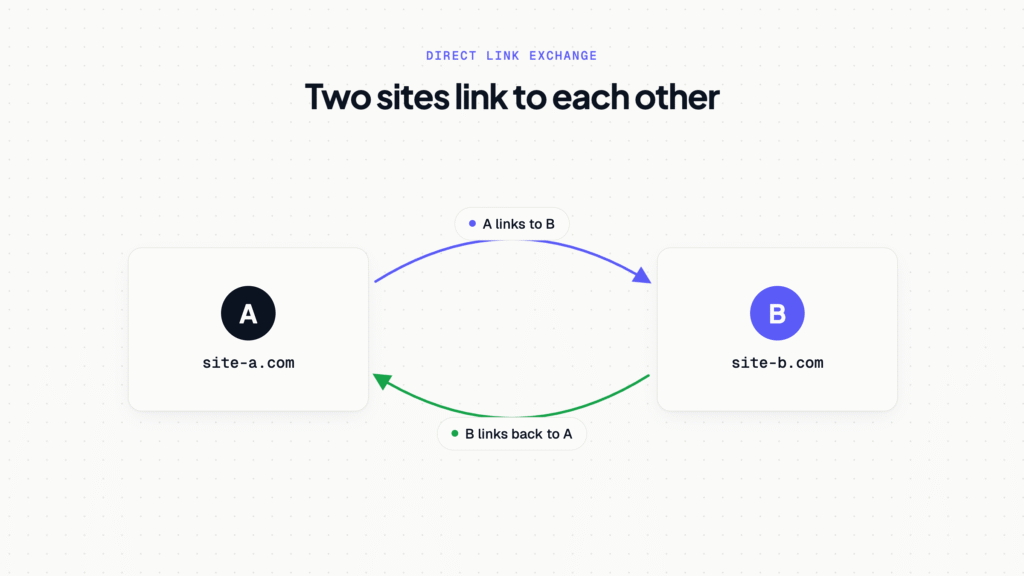
It’s simple and still widely used. If both websites are contextually relevant to each other and the links genuinely add value for readers, there’s usually nothing wrong with it.
2. Guest Post Swap
In this type of exchange, you and another website publish guest posts for each other.
For example, you write an article for their blog and include a link to your website. They later do the same for you.
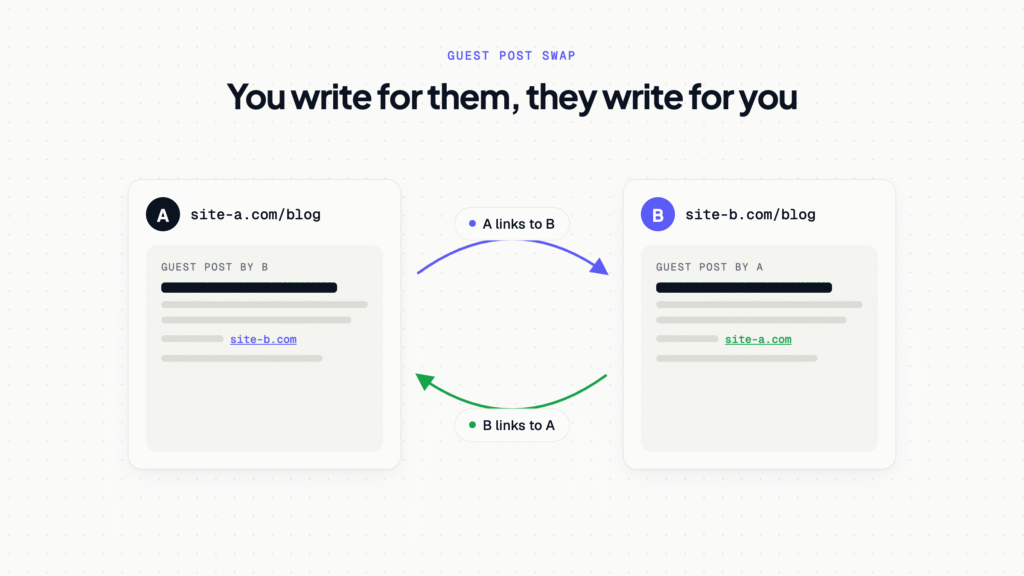
Because the links are placed naturally within useful content, guest post exchanges often look more genuine than direct link swaps.
3. Three-Way Link Exchange
Also called, ABC link exchanges, involves three websites to make the pattern less obvious to search crawlers.
Here’s how it works:
- Website A links to Website B.
- Website B links to Website C.
- Website C links back to Website A.
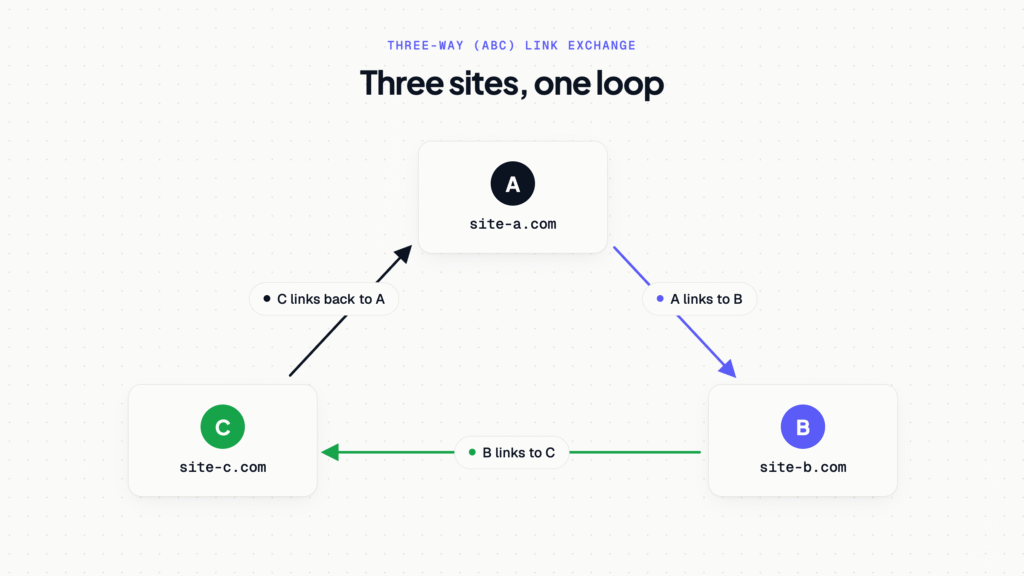
Since there isn’t a direct “I’ll link to you, you link to me” pattern, these exchanges are harder to detect than standard reciprocal links. That’s why many link builders prefer this approach.
4. Private Link Building
This is the riskiest type of link exchange.
Instead of just two or three websites, a group of websites is controlled by the same person or company and used to exchange links with each other. These are often called Private Blog Networks (PBNs).
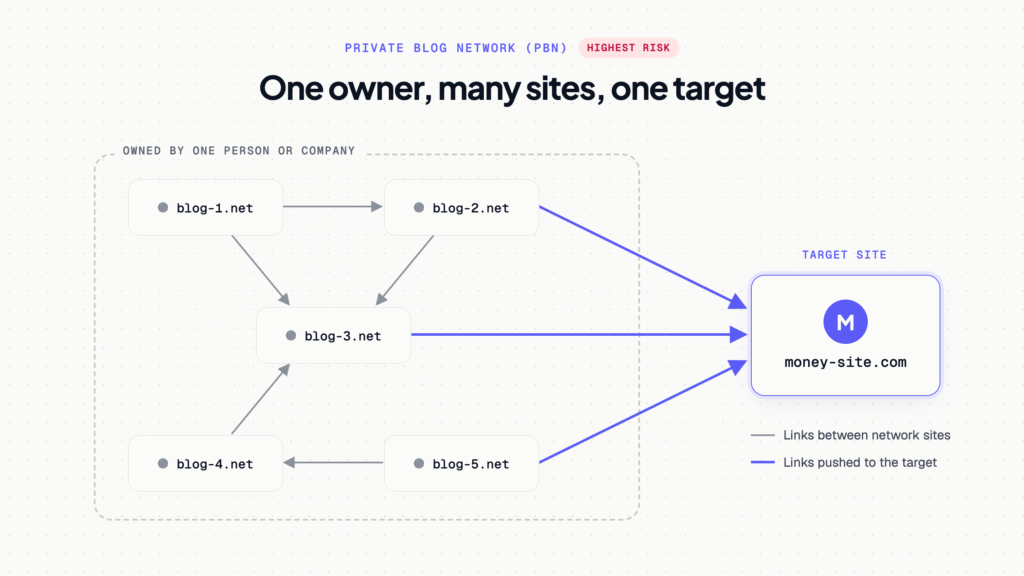
The only goal is to pass SEO value through backlinks, not to help users.
Google considers PBNs a black-hat SEO tactic. If the network is detected, the websites involved can lose rankings or even receive manual penalties.
The SEO Benefit of Reciprocal Links
Link exchanges are still popular because backlinks remain one of Google’s important ranking signals.
When a trusted and relevant website links to your page, it passes authority (often called link juice) and tells search engines that your content is worth considering.
Note: This only works when you’re exchanging links with quality, contextually relevant websites. A backlink from a spammy or unrelated site is unlikely to help and may even do more harm than good.
Some of the biggest benefits of link exchanges:
1. Boost in Authority
Gaining quality backlinks from authoritative sites can improve your Domain Authority (DA) and Domain Rating.
2. Referral Traffic
Beyond SEO, a link on a relevant partner’s site drives direct customer engagement and traffic.
3. Relationship Building
It helps you to build relationships with bloggers, businesses, publishers, and website owners in your niche. This can lead to future guest posts, partnerships, tools integration, content collaborations, and more link-building opportunities.
4. Stronger Topical Authority
Getting links from websites in your niche reinforces your expertise. hese links also help search engines understand your website’s main topics.
5. Faster Backlink Growth
Link exchanges help you build relevant backlinks faster. Instead of waiting for other websites to mention your content naturally, you can reach out to relevant site owners and exchange links.
6. Cost-Effective Link Building
Compared to paid placements or digital PR campaigns, link exchanges can be a budget-friendly way to grow your backlink profile.
Do Link Exchanges Still Work in 2026?
Yes, they do. But only when you do them the right way.
A study by Ahrefs found that around 74% of websites with strong Google traffic have reciprocal links. That means Google doesn’t automatically penalize websites just because they link to each other.
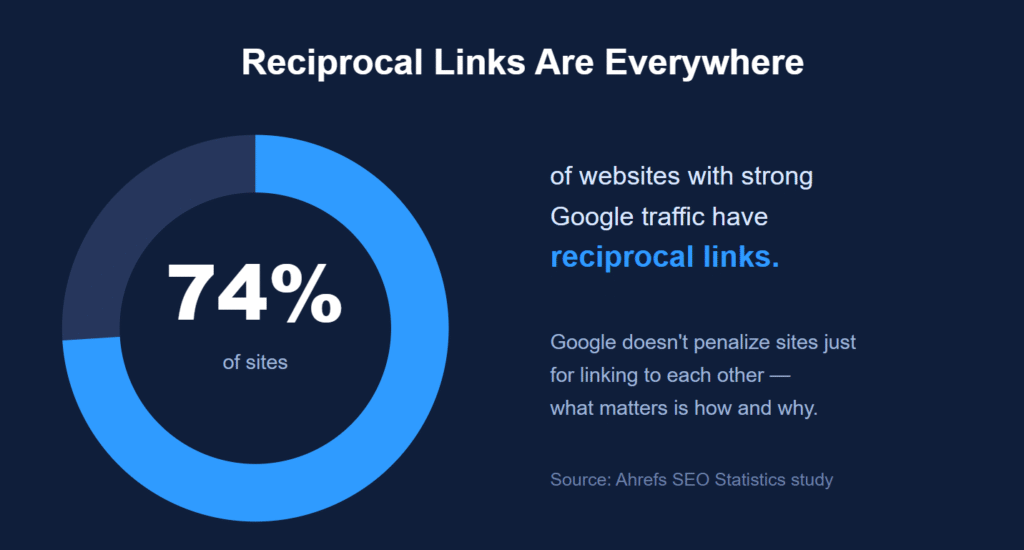
What matters is how and why you’re exchanging links.
Are Link Exchanges Safe?
Yes, but with conditions.
Google’s webmaster guidelines don’t ban all link exchanges. They warn against excessive reciprocal linking that’s done only to manipulate search rankings.
There’s a big difference between exchanging a few relevant, contextual links and swapping hundreds of links with unrelated websites.
If Google detects a pattern of unnatural link exchanges, it may:
- Ignore those backlinks, so they pass little or no SEO value.
- Issue a manual penalty in serious cases, which can hurt your rankings or even remove your pages from search results. This type of search engine manipulation is often referred to as spamdexing.
Note: Keep your link exchanges relevant, natural, and limited. Focus on quality over quantity, and only exchange links that genuinely add value for your audience.
When Reciprocal Linking is Considered Safe
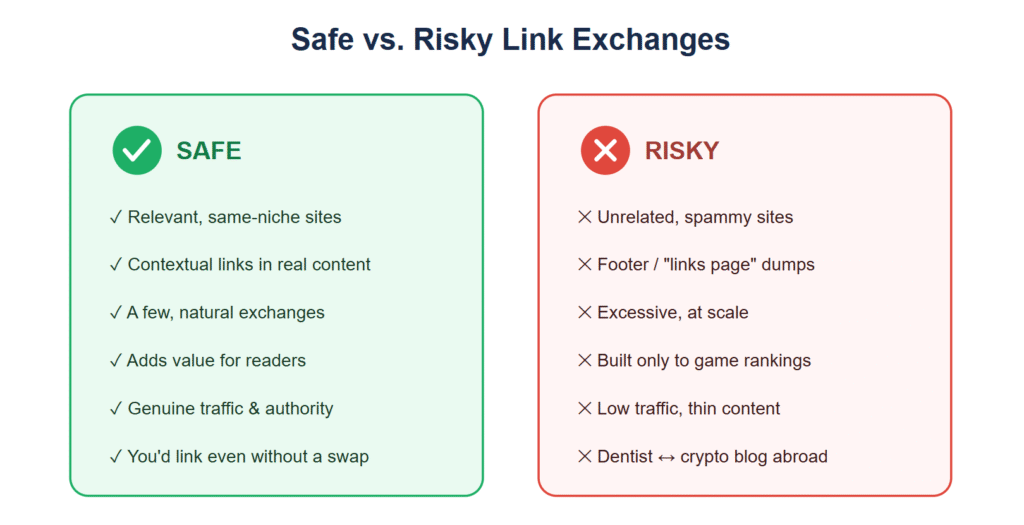
Reciprocal linking is considered natural when there is a logical overlap. If linking to another website makes sense for your content and gives your readers additional value, Google is unlikely to see it as a problem.
For example, You run an SEO blog with a guide on keyword research. An SEO tool website links to your guide because it helps their readers. In return, you link to their tool review as a useful resource for your audience.
Since both links are contextually relevant and add value, this is a natural reciprocal link.
When It Becomes Risky
It becomes dangerous when you agree to link with spammy sites or engage in excessive link building with sites that have no relevance to your content.
If you are a dentist in Chicago exchanging links with a crypto blog in Russia, you are likely to raise red flags.
Note: Google is very good at identifying low-quality link schemes. Aim for relevance over volume.
How to Execute a Safe Link Exchange Strategy
If you’re considering a link exchange, focus on building partnerships, not simply exchanging links. Here is how to do it safely:
1. Identify Relevant Sites
Exchange links with websites that are contextually relevant to your niche. The more closely related your audiences are, the more valuable the link will be for both SEO and your readers.
Link exchanges are generally safe if the two sites operate in the same industry but aren’t direct competitors.
2. Vet the Partner Site
Before you want to exchange, use tools like Ahrefs or Moz to analyze the potential partner.
- Traffic: Do they have genuine organic search traffic?
- Authority: Are they authoritative sites or brand new blogs?
- Outbound Links: Do they link to thousands of spammy or unrelated sites? If so, stay away.
3. Focus on Content, Not Just Links
The best seo strategy for link exchanges is the guest post. By offering high-quality content to another site, you do knowledge exchange. It’ll be a better contextually relevant link than a simple niche edit.
4. Keep Link Exchanges Limited
Don’t make reciprocal links your primary link-building strategy. A few natural exchanges are fine. Relying on them for most of your backlinks can create an unnatural link profile.
With link exchange, try to get some organic links or connect with link building agencies for some paid links as well.
5. Direct Outreach
Don’t send the same email to dozens of websites. Take a few minutes to learn about the site before reaching out.
Mention a specific article you read and explain why a link exchange would benefit both audiences. A personal message is much more likely to get a response than a generic outreach email.
Sample Outreach Approach:
Hi [Name], I came across your article on [Topic] and found it really helpful. I recently published a guide on [Related Topic] that your readers might find useful too. If you think it’s a good fit, I’d be happy to explore a link exchange or content collaboration.
6. Track Your Exchanged Links
Use BacklinkCRM.io to manage your link exchanges. It’ll help you to save time and also track every link exchange you do over a period of time.
Alternatives to Link Swapping
Link exchanges can work, but they shouldn’t be your only link-building strategy. Diversify your link profile with these methods:
- Digital PR – Share original research, insights, or stories that publishers and journalists want to cover.
- Broken Link Building – Find broken links on relevant sites and suggest your content as a replacement.
- Resource Page Link Building – Get your content featured on resource pages that recommend useful tools or guides.
- Niche Edits – Add your link naturally to an existing article where it provides value.
- Unlinked Brand Mentions – Reach out to websites that mention your brand but haven’t linked to your site.
- Create Link-Worthy Content – Publish original research, free tools, templates, or in-depth guides that people naturally want to reference.
- Build Industry Relationships – Connect with bloggers, publishers, and businesses in your niche. Strong relationships often lead to natural backlinks over time.
Conclusion
Link exchanges can be a valuable part of your SEO strategy, but only when you use them the right way.
Focus on exchanging links with relevant, trustworthy websites that genuinely add value to your readers. Avoid swapping links just to increase your backlink count, as that can do more harm than good.
A simple rule to follow is this: If you’d still link to that website even if they didn’t link back to you, it’s probably a good link.
Quality always beats quantity. Use link exchanges in moderation, combine them with other link-building strategies, and focus on creating a backlink profile that looks natural and earns Google’s trust.
Frequently Asked Questions
1. What is link exchange in SEO?
A link exchange is when two websites agree to link to each other’s content. The goal is to earn backlinks that can help improve visibility in search results.
2. What are the risks of link exchange?
The main risks of link exchange include search engine penalties, low-quality backlink profiles, and loss of site credibility. If you exchange links excessively or with irrelevant websites just to improve rankings, it can violate search engine policies.
To avoid these risks, only exchange links with relevant, trustworthy websites and make sure the links add value for your readers.
3. Are link exchanges bad for seo?
Not always. They’re generally fine when they happen naturally between relevant websites and the links provide value to readers. Problems arise when link exchanges become excessive or are done only to influence rankings.
4. Can reciprocal links still have value?
Yes. A reciprocal link can be valuable if it comes from a relevant and trustworthy website in your niche. Besides helping with SEO, it can also bring referral traffic and introduce your content to a new audience. On the other hand, reciprocal links from spammy, low-quality resources do not hold any value.
5. What is the safest type of link exchange?
The safest link exchange is one between relevant websites where the links are added because they’re genuinely useful. Whether it’s a direct exchange or a three-way (ABC) exchange, the link should fit naturally within the content and help your readers. If the link adds value first and SEO benefits second, you’re on the right track.