
Contextual backlinks are the backlinks Google loves the most in 2025 and 2026.
You’ve probably heard SEO experts talk about the importance of Quality Backlinks. Most of the time, they’re referring to contextual backlinks, which are placed naturally within the content.
Contextual backlinks help build your topical authority, improve CTR (click-through rate), and provide real value to the readers.
What really matters to Google is who is linking to you and why.
If a reputable website in your niche refers to your website or specific content, that’s a strong signal that your website is credible as well.
That’s why you should try to get contextual backlinks from high-authority websites. That way, you can easily outrank your competitor who has a thousand random links from irrelevant websites.
What are Contextual Backlinks?
Contextual backlinks are hyperlinks naturally placed within the main content of a webpage – this could be a blog post, an article, or any other content piece.
These links either lead to the same website or to external sources. The most important thing about contextual seo backlinks is RELEVANCE. The linked page should be directly related to the content it appears in.
In simple terms, these links are placed within the surrounding text to add value to readers, either to provide additional information about the content or to support the topic being discussed with stats.
Let’s take an example of digitalmarketinginstitute.com blog, they have an article on “Email Marketing Complete Guide,” and from that, they linked to another article on the anchor “buyer personas” as shown in the image below. This is a perfect example of a contextual backlink.

Types of Contextual Backlinks in SEO
1. Internal Contextual Links
2. External Contextual Links
3. Inbound Contextual Links
1. Internal Contextual Backlinks
Internal Contextual links are the backlinks within your own website content that connect to other pages on your website.
These links help users navigate more of your content. Plus, they help search engines understand your website’s structure. (It is also called internal linking)
Example:
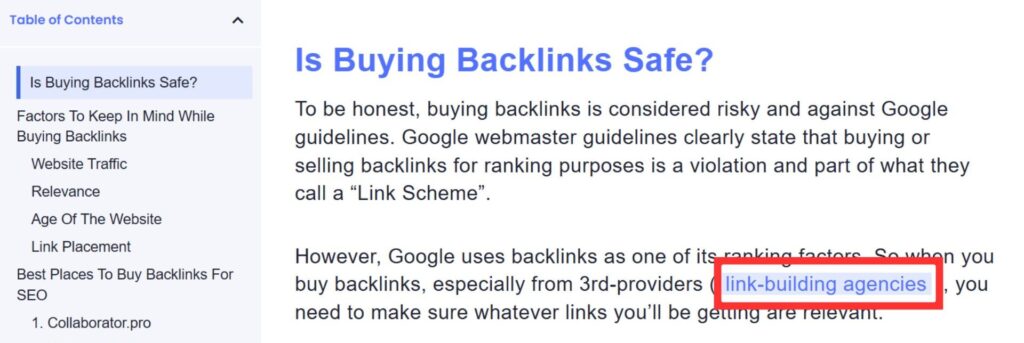
In the above article on our other website aryanjalan.com. We have a topic “best places to buy backlinks”, and we have added an internal contextual link to our other article on “link-building agencies”.
Since this section discusses third-party backlink providers, it makes sense to link to relevant content that lets users explore trusted agencies if they’re looking for them.
2. External Contextual Backlinks
External Contextual Backlinks are links within your content that point to other websites. They are useful because the linked websites often provide additional information related to the topic you’re discussing or some credible sources.
This helps enhance the reader’s understanding and adds credibility to your content.
Example:
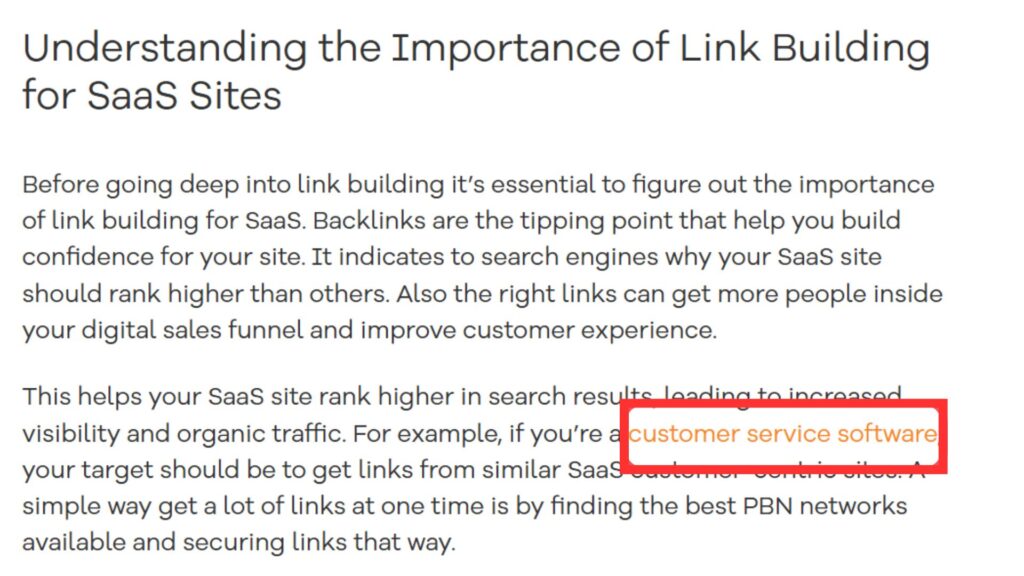
The above article is about “How to build links to your SaaS site?” and they have added an external contextual link in the above section, with an anchor text to “customer service software”. This means they have naturally linked it to another helpful article titled “Best customer service software.”
Since the linked article directly supports and adds more value to the topic being discussed, it’s a great example of an external contextual link.
3. Inbound Contextual Backlinks
Inbound Contextual backlinks are links from another website to your site. If a relevant website links to your page naturally within its content, that’s an inbound contextual backlink. These links are good for SEO and building site authority.
Example:
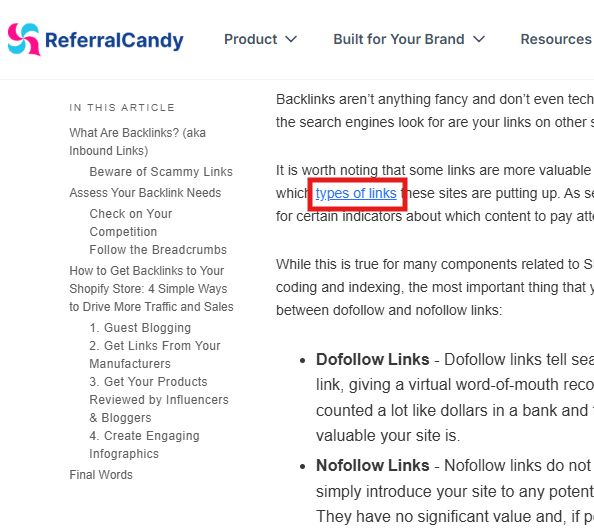
In Referral Candy’s article on “4 Super Easy Ways To Build Backlinks To Your Shopify Store,” they talk about what backlinks are. To make it more helpful, they used the anchor text “types of links” and linked it to our article on quality backlinks on our website,aryanjalan.com.
Since the link fits naturally within their content and connects to our site, it’s an inbound contextual link for us. It signals to search engines that our website’s content is trustworthy and authoritative within that topic area and helps us bring more traffic to our site.
Benefits of Contextual Link Building
High Referral Traffic
Contextual links appear inside useful content. They match what the user reads. So, clicks happen more naturally. This brings more referral traffic to your website.
How beneficial is it?
This works great when you’re getting referral traffic to your landing pages. Such backlinks help you get sales directly.
Higher Domain Authority
Trusted websites pass on their authority. Good contextual backlinks act as SEO boosters. Google sees them as signals of trust. The more high-quality contextual links you gain, the more Google trusts your content.
How beneficial is it?
It increases your ranking authority. A higher authority makes it much easier and faster for your future content to reach the first page on Google
Better Rankings
Contextual links use keyword-rich anchors. They help Google understand your page. Relevance and niche-matching matter a lot. These links support better keyword rankings. Pages rank higher over time.
How beneficial is it?
It brings consistent organic traffic with high intent. A higher ranking on your business keywords means you’re getting business without paying for every click.
Niche Relevancy
Niche-relevant links come from websites in your specific industry. It shows you belong in that niche. Google uses these signals to categorize your site.
How beneficial is it?
It builds topical trust. When Google sees you linked by industry websites, it recognizes you as an expert. This helps you rank for the right keywords much faster.
Popular Practices to Get Contextual Backlinks For Free
1. Create High-quality content
Creating high-quality content should be your top priority if you’re looking for free, organic, high-quality backlinks. Like you, every editor wants to add updated and the latest references and resources within their website and pages.
So what works?
Think of detailed, unique studies, comparison posts, templates, or tools. Content that solves a specific problem or goes deeper than others in your niche.
Keep your content updated, well-structured, and optimized for both users and search engines.
Example: A well-written article titled “How to do a 3-Way Link Exchange in 2026” with real examples and outreach scripts is far more link-worthy than a basic post on “What is a Backlink?”
👉 This approach earns inbound links naturally. It also improves internal linking opportunities when you interconnect related pages. Plus, when you cite sources and add useful external links, it adds more credibility to your content.
2. Contribute to a Guest Post
Guest Posting is a solid link-building strategy when done the right way. It’s simply about writing useful content for another website in your niche and earning a contextual seo link back to your site.
Here, you have the freedom to decide which page to link to and what anchor text to use.
While creating the content, just make sure the contextual link is placed where it actually makes sense.
On top of that, your brand gets in front of a new audience, which helps with visibility and credibility.
Before pitching, review your competitors’ backlinks.
Tools like Ahrefs or Semrush can show you which blogs they’ve written for. List the sites that are active, relevant, and have decent traffic.
When you reach out, focus on value addition. Pitch helpful topic ideas, not promotional ones, it’ll look like another backlink email they’re not interested in.
👉 This is a great way to build inbound links from authority sites. It also helps reinforce your external link profile if you cite good sources, and improves internal SEO if you plan a content cluster around guest posts.
3. Implement Broken-link building
Most articles link out to other websites. Over time, some of those links break or lead to dead pages. That’s where you have to step in.
Find broken links on websites in your niche, then reach out and suggest your content as a replacement.
Broken links damage user experience – and site owners are usually happy to fix them if you help. You can spot them using Chrome extensions or by checking your competitors’ backlink profiles.
Once you identify broken URLs, suggest your existing page as a replacement or create a new one, and then share it.
Keep your outreach helpful and simple. You’re doing them a favor, not asking for one.
👉 This helps you earn contextual inbound links while showing you’re proactive. If you build a fresh piece to replace the broken one, it’s also a great way to create new internal linking touchpoints.
4. Manual link-building Outreach
Manual outreach is about directly connecting with blog editors or content managers. Instead of pitching a full guest post, you offer to contribute a short section to an already published article, usually with a relevant backlink included.
It works well because it saves time. You don’t have to write a full article from scratch, yet you still earn an in-content, contextual backlink.
Just make sure your suggested page is relevant. It should fit naturally and add value to their article. If it feels promotional or forced, it’s likely to be ignored or removed.
👉 This method builds inbound links quickly. It also helps with external linking if your added snippet refers to stats, examples, or sources. And you can internally link your inserted content back to other relevant pages on your site.
5. Pitch to Resource Pages
Resource pages are curated lists of useful articles, tools, or guides. They exist on educational, SaaS, nonprofit, and marketing blogs. These are great for getting clean, editorial links, contextual backlinks – without creating new content.
Start by searching for terms like “{your topic} + resources” or “helpful tools for {your niche}”. Find pages that are still active and accept new suggestions.
Pitch your content with a short reason why it adds value. For example, a Free SEO Template for Outreach Tracking would fit well on a Resources for Link Building page.
👉 This method earns inbound links from trusted sources. It also pushes you to keep your page optimized and internally structured. Add a few external references within the page to make it even more valuable.
6. Use HARO or Qwoted for Press Mentions
HARO (Help a Reporter Out) and Qwoted connect journalists with expert quotes. You sign up, monitor daily requests, and respond to the ones in your niche.
If selected, your quote gets published — often with your name, company, and a backlink. These links usually come from strong websites: news outlets, SaaS blogs, or B2B platforms.
To succeed, respond fast. Keep your answers short, insightful, and jargon-free. Over time, this builds a natural, high-authority backlink profile — with zero cold emails.
👉 This is one of the most trusted ways to get inbound links. Even if you don’t control the anchor text, the link placement is natural. You can later link back to these mentions from your internal content, building a credibility loop.
Apart from the above methods…
You can also build hundreds of quality contextual backlinks just by partnering with content managers at companies in your niche. It doesn’t always have to be cold outreach or guest posts.
I’m talking about barter deals – like guest post swaps, 3-way link exchanges, or even link-for-link edits. If you have a good link prospecting tool to find backlink exchange partners, these deals are faster, more scalable, and work especially well when both sides are trying to grow.
But here’s the real issue: Once you’re managing 10–15 of these deals at a time, it gets messy. Spreadsheets fall apart. Emails get lost. People forget. Links don’t go live.
That’s exactly why I built BacklinkCRM — a tool that helps SEO folks and agencies manage all their backlink partnerships in one place. We use it every day to:
- Handle 1:1, 2:3, and 3:2 link exchanges fairly
- Track which links are live, pending, or broken
- Keep a clean record of all collaborations
- Avoid link drops, delays, and messy follow-ups
If you’re running multiple link-building campaigns or working with partners across different projects – this saves serious time.
👉 It’s not just for inbound links. You can also track internal opportunities and external links placed across projects. Everything stays organized.
Conclusion
Contextual backlinks are one of the best ways to improve your website’s SEO. When links are placed naturally inside relevant content, they help search engines understand your page and give users more helpful information.
Focus on creating useful content, building real connections, and using simple strategies like guest posts or broken link outreach. Over time, this leads to better rankings, more traffic, and stronger authority.
Explore More: Best Link Building Companies 2026
FAQs on Contextual Backlinks
1. What’s the difference between contextual and non-contextual links?
Ans- Contextual Links = Inside the main content of the page. Also called as editorial links.
Non-contextual Links = In sidebars, footers, or menus.
2. Why should I use contextual links instead of other types?
When you use contextual backlinks in your content, it helps Google to understand the relationship between the two pages. This way the articles get indexed quickly and you get a chance to rank on specific keywords.
3. What are the main benefits of contextual link building?
The primary benefits of contextual link building include higher referral traffic, boosted domain authority, and improved credibility. Because you use contextual links within a specific topic, they signal to search engines that your site is a trusted leader in that niche.
4. How do I find opportunities for my contextual link building strategy?
The best way to start is by checking your competitors' backlinks profile. By seeing your rivals earn their relevant links, you can identify high-authority sites in your niche that are already open to linking out to quality content.
5. What makes a contextual link strong?
A strong build contextual link comes from a trusted website, is placed naturally within the content, and is relevant to the topic being discussed.
6. How do you add a contextual link?
To add a contextual link to your website, just pick a word or phrase in your content and link it to a page that adds value or gives more info about that topic.
7. Is it safe to buy contextual backlinks?
You must be cautious. Ensure your backlink provider uses manual outreach to secure placements on real, high-traffic sites. Low-quality, automated links can hurt your ranking rather than help i
Read More About:
Best SaaS Link Building Agencies in 2026
What Is A Good Authority Score On Semrush?
