
DA or DR or AS. Which is considered as the best authority for backlinks?
None of them come from Google. All these DA, DR and AS are by SEO tools. After Google discontinued the public page rank number in April, 2016.
First Moz introduced its metrics called Domain Authority (DA). DA is still considered as the benchmark for OLD SEO and in general as well.
But if you’re from a new age business and follow new trends you might find that Domain Rating aka DR is getting popular which is owned by Ahrefs.
While very few selected companies and SEO professionals consider Semrush Score aka Authority score as their prime metrics to consider the website authority.
Overall – all these metrics are just giving you a rough idea about the authority of the website and the probability of how good a website is. One metric from Moz is still very popular called “spam score”.
Which Metric Is Best for Backlinks?
- Domain Authority (DA) by Moz: Best for long-term authority tracking
- Domain Rating (DR) by Ahrefs: Best for backlink research and prospecting
- Authority Score (AS) by Semrush: Best for reducing risk when buying paid links
DR vs DA vs AS: Quick Comparison Table
| Metric | Domain Authority (DA) | Domain Rating (DR) | Authority Score (AS) |
| Created By | Moz | Ahrefs | Semrush |
| Introduced | After PageRank removal | 2016 | 2018 |
| Score Range | 1–100 (logarithmic) | 1–100 (logarithmic) | 1-100 score |
| Prime Focus | Overall domain authority | Backlink profile strength | Backlinks, organic traffic, spam signals |
| Considers Organic traffic | No | No | Yes |
| Considers spam/risk signals | Limited (Moz Spam Score) | – | Strong |
| Factors considered to calculate | Backlink quantity & qualityLinking root domainsMozRankMozTrustSpam ScoreSite structureContent relevance | Unique referring domainsStrength of linking domainsOutgoing links from referrersDofollow link | Backlink qualityReferring domainsOrganic trafficKeyword rankingsSpam & risk signals |
Understanding the Main Authority Metrics
What Is Domain Authority (DA)?
Domain Authority (DA) was introduced by Moz.
It was one of the first authority metrics introduced after Google’s PageRank disappeared, and even today, it is widely used in SEO to evaluate a website’s strength.
DA basically predicts how likely your website is to rank in search engine results pages (SERPs) when compared to other websites in your niche.
Domain Authority scores range from 1 to 100. A higher score usually means a website has a better chance of ranking well in search results.
Remember: Many people think the main goal is to keep increasing the DA score and eventually reach 100, but that’s not how DA is meant to be used. True value comes from comparing your site with your true competitors’ sites in the same category, and targeting the same or similar keywords and topics.
How is the Domain Authority (DA) calculated?
Moz calculates DA using machine-learning models that analyze around 40 different signals, with a strong focus on backlink you’ve.
Some of the key factors involved are:
- Linking root domains (how many unique sites link to you)
- Total backlinks (quality + quantity)
- MozRank and MozTrust
- Spam score
- Content relevance and quality
- Site Structure
- Domain age
And more.
All this data comes from Moz’s Link Explorer index and is compared with real SERP rankings across thousands of search results to predict your ranking potential.
DA follows a logarithmic scale, which means the higher your score gets, the harder it becomes to grow further.
Note: Moz’s Spam Score is still one of the most useful Moz features and is often checked separately when evaluating risky sites.
What Is Domain Rating (DR)?
Ahrefs Domain Rating (DR) is another popular SEO term, used by SEO professionals to check a website’s authority. Introduced by Ahrefs in 2016, it’s similar to Moz’s DA but primarily focuses on your backlink profile.
DR measures how strong a website’s backlinks are (both in quality and quantity) on a 100-point scale. Simply put, it tells you how powerful your website’s backlinks are compared to your competitors.
Like our Backlinkcrm.io DR is 44
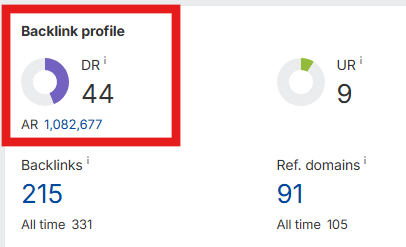
SEO professionals use DR to see how many links point to a site before targeting it for link-building. A higher DR usually means a stronger backlink profile. It’s best in terms of comparing websites in the same niche and finding opportunities to boost your own site’s authority.
Note: DR scores are updated regularly, so you always get a current picture of a website’s link strength.
How is Domain Rating Calculated?
Ahrefs Domain Rating is calculated purely on link-based, and does not appear to take into account any other signals. It uses a logarithmic 0–100 scale. A higher score means your site is more authoritative.
Key factors it primarily considers:
1. Unique Referring Domains
DR is driven more by how many different websites link to you, not how many total links you have. Ten links from one site still count as one, so always focus on earning links from multiple relevant sites.
2. Strength of Linking Websites
Not all backlinks are equal. Links from high-DR websites pass more authority, while low-DR sites pass less (but can grow in value as they improve over time).
3. Outgoing Links from Referring Domains
If a site links out to many other domains, its link juice gets divided. Fewer outgoing links usually mean more value passed to your site.
4. Dofollow Links Only
DR is calculated almost entirely using dofollow backlinks. Nofollow links don’t increase DR directly, but they help keep the backlink profile natural.
What Is Authority Score (AS)?
Authority Score is Semrush’s compound metric that measures your website’s (or webpage’s) overall quality and SEO strength on a scale from 0 to 100.
A higher Authority Score generally means better chances of ranking well on SERPs, but the score is most useful when you compare it with similar websites in the same niche.
Unlike DA or DR, which focus heavily on backlink strength, AS considers link trust, traffic quality, and overall site health. This makes it easier to judge whether a website has a good authority score relative to others in the same niche.
How is Authority Score Calculated?
Semrush calculates Authority Score by looking at a few core trust signals together, not just one metric. Let’s check:
1. Backlink Profile Strength
This is about the quality and trustworthiness of links, not just the number. Semrush checks:
- How many unique websites link to you?
- How authoritative and reliable are those sites?
- Whether the links look natural or spammy?
- How diverse are your referring domains?
A few strong, relevant backlinks can boost your Semrush Authority Score far more than hundreds of low-quality ones.
On the flip side, things like an unnatural dofollow-to-nofollow ratio, lots of links with no traffic, or links coming from the same network can pull your score down.
2. Organic Traffic & Visibility
Semrush also looks at how your website actually performs in search. It checks things like your estimated monthly organic traffic, keyword rankings, and how your traffic is growing or declining over time. So it’s not just about links, it also considers real search performance.
3. Spam & Risk Signals
Semrush keeps an eye out for risky or spammy link patterns. For example, if a site suddenly gains a large number of unnatural links or gets too many links from the same IP address, it can flag those as potential manipulation.
Important note: Even though Semrush Authority Score has its strengths, it’s still not used as widely as Domain Authority (DA) or Domain Rating (DR). Most SEOs continue to rely on DR simply because it’s familiar and fits easily into their everyday SEO workflows in 2026.
How to Check DA, DR, and AS for Free (Without Logging In)
If you’re doing quick research and don’t want to log in to tools like Ahrefs, Semrush, or Moz, you still have plenty of options.
All three platforms offer free authority checkers. And beyond that, there are third-party tools that let you check Domain Rating, Domain Authority, and related metrics instantly, just by entering a URL.
These tools are especially useful in the early vetting stage, when you want to filter backlink prospects quickly before spending time, money, or paid credits.
Free Tools from Ahrefs, Moz, and Semrush
These are official free tools provided by the SEO platforms themselves. They’re limited, but reliable for quick checks.
- Ahrefs Website Authority Checker (Free)
Shows Domain Rating (DR), total backlinks, and referring domains.
Free tool link: https://ahrefs.com/website-authority-checker - Moz Free DA Checker
Lets you check Domain Authority (DA), linking domains, keyword ranking distribution, top pages by links and basic spam indicators.
Free tool link: https://moz.com/domain-analysis - Semrush Website Authority Checker (Free)
Shows Authority Score (AS) along with basic backlink and domain data.
Free tool link: https://www.semrush.com/free-tools/website-authority-checker/
These SEO tools won’t give you full backlink breakdowns, but they’re accurate enough for a quick snapshot.
Third-Party Authority Checker Tools (No Login Required)
If you want faster checks or prefer not to use platform-specific tools, these third-party options are commonly used:
- SEO.AI Domain Rating Checker
Useful for checking DR and backlink-related signals quickly. - RhinoRank DA & DR Checker
Shows both Domain Authority and Domain Rating in one place. - SmallSEOTools Domain Rating Checker
Helpful for quick DR checks and basic comparisons across multiple sites.
These tools are great when you’re reviewing multiple sites at once or doing bulk outreach research.
While free tools don’t show deep backlink data, they’re good enough to:
- Get a quick DA, DR, or AS estimate
- Compare multiple websites quickly
- Spot obvious red flags early
- Shortlist sites for deeper analysis later
Once a site passes this initial check, you can then move to paid tools for a more detailed backlink and traffic review.
Which Authority Metric Should You Actually Track?
From our experience, there’s no single metric that fits every situation. Every authority metric has a specific role. None of them are good or bad on their own. It all depends on what you’re trying to decide.
In our backlinkcrm team, when we’re evaluating any website for link building, we primarily look at two things first: DR, organic traffic number, top keywords, and their location.
As you can see, one of our competitor BacklinkManager, they’re getting 79% traffic from the US and ranking on the similar keywords which we also wanted to rank better.
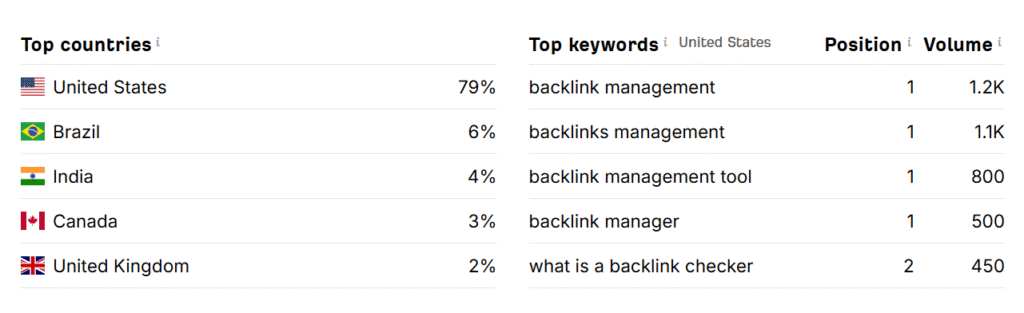
If a site has decent DR, ranking on relevant keywords and growing traffic, it’s usually a good sign that the site has real authority.
DR is what we consider most when:
- Shortlisting websites for backlinks
- Comparing competitors of backlinkcrm
- Deciding whether a site is worth outreach
And we use DA to analyse the paid websites spam score. It helps us understand if the paid website is a good place to go in some cases or if we’ve to add it to our blacklist.
And so far, we’re not using the Semrush Authority score.
